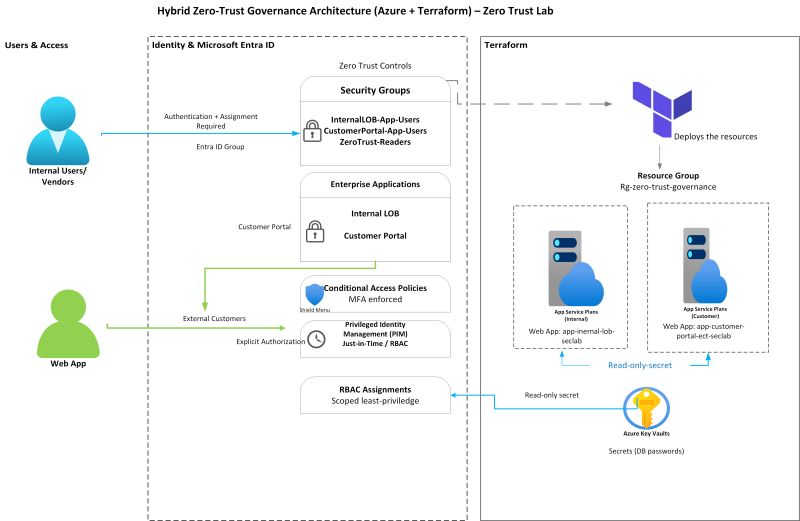
Many Information Technology professionals begin their careers as Systems Administrators where they manage servers, networks, Active Directory environments, virtualization platforms and security policies. As organizations accelerate cloud adoption, manual infrastructure deployment is becoming increasingly difficult to maintain. Modern enterprises require infrastructure that is secure, repeatable, scalable and fully automated.
This is where DevOps practices and Infrastructure as Code (IaC) become essential. One of the biggest challenges during a cloud transformation journey is maintaining strong security while enabling rapid infrastructure deployment. The solution lies in combining Zero Trust security principles with Infrastructure as Code tools such as Terraform and cloud identity platforms such as Microsoft Entra ID.
Understanding Zero Trust
Zero Trust is built on a simple principle: Never Trust. Always Verify. Unlike traditional security models that assume users inside the corporate network are trustworthy, Zero Trust continuously validates users, devices and workloads before granting access.
Core Zero Trust principles include:
- Verify every identity
- Enforce least privilege access
- Assume breach
- Continuously monitor activity
- Automate security controls
For DevOps teams this means infrastructure should never be deployed using excessive permissions or unmanaged identities.
The Traditional Infrastructure Challenge
In many organizations infrastructure deployment still follows a manual process. Administrators create virtual machines, configure networking, assign permissions, deploy applications and configure monitoring tools individually.
This approach introduces several challenges including human error, configuration drift, inconsistent deployments, security gaps and slow delivery cycles. A single incorrectly configured service account or over-privileged administrative role can create significant security risks.
Infrastructure as Code with Terraform
Terraform allows engineers to define infrastructure through code rather than manually configuring resources through cloud portals. Infrastructure becomes version controlled, repeatable and easily auditable.
resource "azurerm_resource_group" "production" {
  name     = "rg-production"
  location = "Zimbabwe"
}
Once the configuration is defined, Terraform automatically provisions the required resources. Benefits include consistent deployments, automated provisioning, reduced human error and faster disaster recovery.
For professionals transitioning from Systems Administration into DevOps, Terraform represents the shift from managing infrastructure through graphical interfaces to managing infrastructure programmatically.
Microsoft Entra ID as the Identity Control Plane
Identity is the foundation of Zero Trust security. Microsoft Entra ID provides centralized Identity and Access Management (IAM) capabilities for cloud and hybrid environments.
Key capabilities include:
- User Authentication
- Conditional Access
- Multi Factor Authentication
- Role Based Access Control (RBAC)
- Privileged Identity Management
- Identity Governance
Rather than assigning broad permissions directly to users, organizations define security policies and role assignments that ensure every action is authenticated, authorized and auditable.
Building the Zero Trust Bridge
The real value emerges when Terraform and Entra ID work together. Terraform can automate not only infrastructure deployment but also identity management and access control.
A modern deployment pipeline can automatically:
- Create Azure resources
- Create security groups
- Assign RBAC permissions
- Configure managed identities
- Apply security policies
- Enforce least privilege access
resource "azuread_group" "devops_team" {
  display_name     = "DevOps-Team"
  security_enabled = true
}
Terraform automatically creates the security group within Entra ID ensuring consistency across environments.
resource "azurerm_role_assignment" "contributor" {
  scope                = azurerm_resource_group.production.id
  role_definition_name = "Contributor"
  principal_id         = azuread_group.devops_team.object_id
}
This approach ensures permissions are assigned consistently every time infrastructure is deployed.
Applying Least Privilege by Design
A key objective of Zero Trust is least privilege access. Instead of granting permanent administrative privileges, Terraform automates the assignment of only the permissions required for specific workloads.
- Developers receive deployment permissions
- Security teams receive monitoring access
- Administrators receive infrastructure management permissions
- Service accounts receive workload-specific access
This significantly reduces the attack surface while improving governance and compliance.
Integrating CI/CD Pipelines
Modern DevOps environments integrate Terraform directly into Continuous Integration and Continuous Deployment pipelines.
                                Git Repository
                                    ↓
                                Pull Request
                                    ↓
                                Terraform Validation
                                    ↓
                                Security Scan
                                    ↓
                                Approval
                                    ↓
                                Terraform Apply
                                    ↓
                                Infrastructure Deployment
                                    ↓
                                Entra ID Access Configuration
Every infrastructure change becomes secure, auditable, repeatable and version controlled. This aligns perfectly with Zero Trust principles.
Why This Matters for Systems Administrators
DevOps does not replace traditional Systems Administration. Instead, it extends existing administration skills through automation and cloud technologies.
Systems Administrators already understand networking, DNS, DHCP, Active Directory, virtualization, monitoring and security. Terraform and Entra ID transform those same skills into code-driven processes capable of operating at cloud scale.
For professionals moving from SysAdmin roles into DevOps, learning Infrastructure as Code and Identity as Code provides a natural progression path. Existing experience managing Windows Server, VMware environments and enterprise networks becomes highly valuable when building automated cloud infrastructure.
Conclusion
Zero Trust is no longer simply a security framework. It is becoming the operational foundation of modern cloud environments. By combining Terraform and Microsoft Entra ID, organizations can automate infrastructure provisioning while ensuring every resource, identity and workload adheres to strict security controls.
The future of infrastructure is not manual configuration. The future is secure automation driven by code, identity and Zero Trust principles. For Systems Administrators transitioning into DevOps, mastering this combination creates a strong foundation for modern cloud engineering careers.